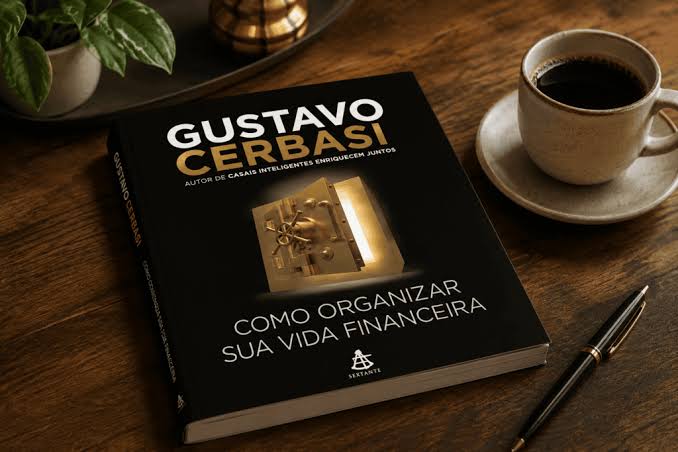
How to Organize Your Financial Life: map expenses and build a reserve
Note: This specific book (“Como Organizar Sua Vida Financeira” by Gustavo Cerbasi) is a Brazilian publication without a direct English edition. However, its core principles on financial engineering and budget mapping are universally applicable.
The previous books showed that money needs to flow into the asset column and that part of what you earn must be saved. In practice, that runs into a common problem: a lack of organization.
This book made me pay more attention to organizing my finances and mapping expenses. I started logging them in a spreadsheet to stay in control.
If I were to summarize it: organization and discipline are more important than large earnings.
Mapping the Variables
You cannot optimize what you cannot measure. Financial lack of control also means spending without knowing where the money goes. Cerbasi divides costs into two groups that need to be mapped:
- Fixed Expenses: Expenses that repeat for three months or more, plus annual costs such as property taxes, vehicle taxes, and credit card or professional board fees.
- Occasional Expenses: This is where most people’s budgets break. These are car maintenance, home repairs, unforeseen medical appointments, and even gifts.
If you do not have predictability over occasional expenses, your financial planning is merely a look at the past.
Risk Management: PMS and PMR
Cerbasi divides the familiar emergency fund into two levels.
The first line of defense is the Minimum Survival Equity (PMS). In Cerbasi’s own words:
“The minimum survival equity (PMS) is what you need to have simply to be able to reorganize your life in the event of unemployment, illness, or frustrated plans in your business activity. It is with this reserve that you will maintain your consumption standard until things normalize.”
The second line of defense is the Minimum Reserve Equity (PMR), which acts as the mathematical target for your peace of mind. As the author points out:
“The minimum reserve equity (PMR) should be a financial reserve equivalent to 12 times your family’s monthly consumption, assuming you are in a stable employment situation. Self-employed individuals, workers without formal employment ties, and professionals with reduced employability should have a PMR equivalent to 20 times their family consumption.”
Public service professionals or military personnel can operate comfortably in the 12-month range, while those in high-turnover private sectors or entrepreneurs need a 20-month “breathing room”.
Strategy for each income profile
Planning should account for your income profile. If your income varies widely, define the minimum you receive each month, an average, and any seasonal pattern in the money coming in.
The Price of Indiscipline
“A financial life full of debts makes you achieve far fewer dreams than you would with planning and discipline.”
I came away from this book thinking that wealth depends less on luck and more on repeated execution. A budget needs clear rules and discipline to work.
Next reading: Smart Investments